
 By adnanshabbir942@gmail.com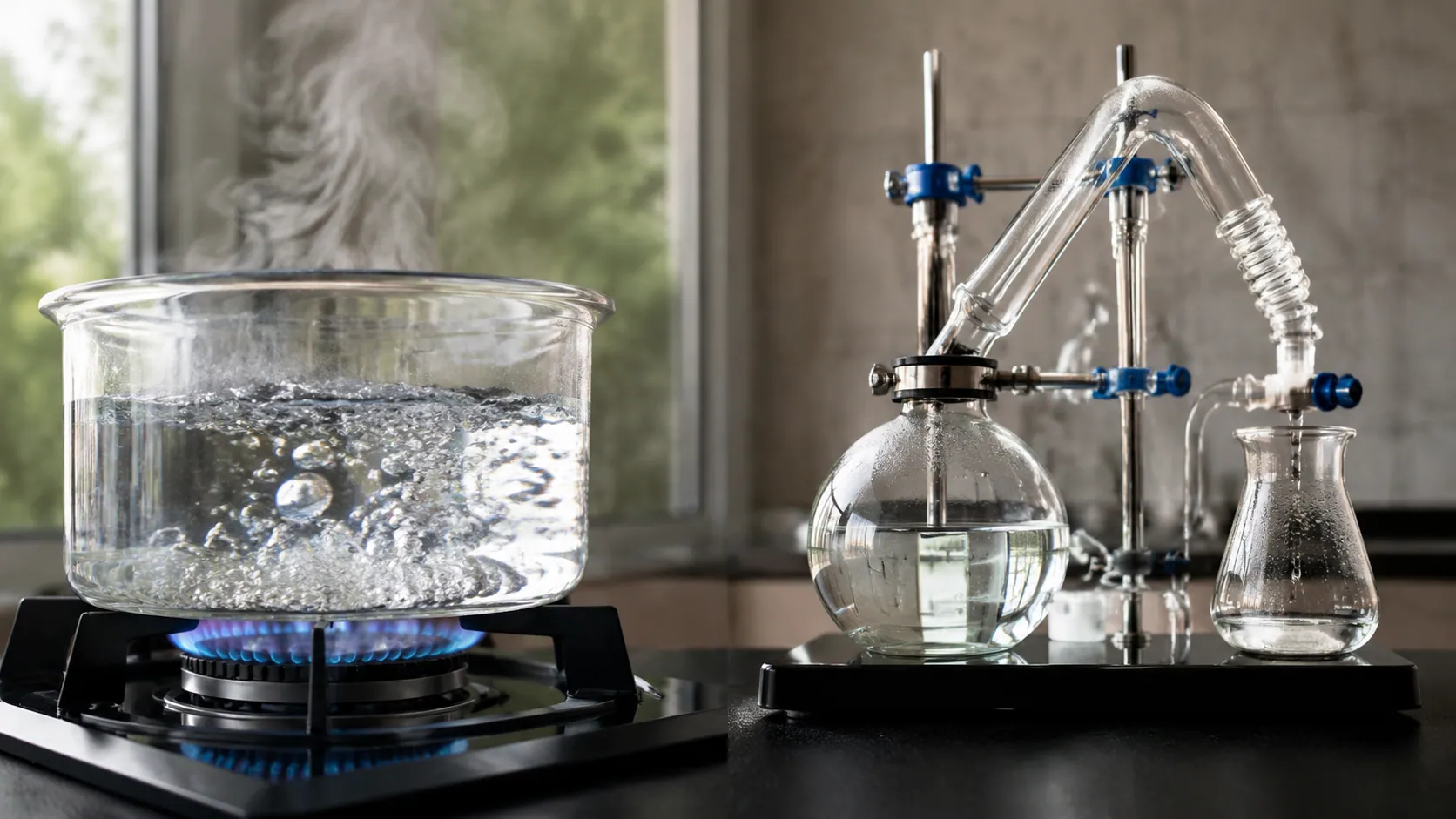
No, boiled water and distilled water are not the same, even though both involve heating water. Boiling water mainly means heating it until it reaches its boiling point, which can help kill many bacteria, viruses, parasites, and germs. Distilled water, however, goes through a more complete distillation process, where water is boiled into steam, collected, cooled, and turned back into liquid.
That difference matters because boiling water does not make it distilled. Boiled water may still contain dissolved minerals, salts, heavy metals, chemicals, and other impurities. Distilled water is usually much lower in minerals because many contaminants are left behind during evaporation and condensation.
So, when comparing boiled water vs distilled water, the best choice depends on your purpose. Boiled water may be useful for emergency drinking situations, while distilled water is often better for CPAP machines, humidifiers, steam irons, medical devices, and other uses where mineral residue can cause problems.
What Is Boiled Water?
Boiled water is water that has been heated until it reaches its boiling point. At sea level, water boils at about 100°C or 212°F. In mountainous areas or at high altitude, water can boil at a lower temperature because of reduced air pressure.
The main purpose of boiling water is usually disinfection. When water is boiled properly, it can kill or inactivate many common microorganisms, including bacteria, viruses, and parasites. This is why boiling is often recommended during a boil water advisory, floods, or other emergency drinking water situations.
However, boiling does not automatically make water pure. If you boil tap water, it may become safer from a germ standpoint, but it can still contain calcium, magnesium, fluoride, lead, PFAS, nitrates, or other dissolved substances depending on the water source.
In simple terms, boiling water kills germs and bacteria, but it does not remove everything. This is one of the biggest reasons people confuse boiled water with distilled water. Boiled water has been heated; distilled water has been purified through steam collection.
What Is Distilled Water?
Distilled water is water made through distillation, a purification process that uses boiling, steam, and condensation. During the distillation process, water is heated until it becomes water vapour or steam. That steam is then collected and cooled in a separate container, where it turns back into liquid. The collected liquid is called distillate.
The important part is that many dissolved minerals and impurities do not travel with the steam. Substances like calcium, magnesium, many salts, and other dissolved solids are mostly left behind in the original container. This is why distilled water is often described as low-mineral water or mineral-free water.
Distilled water is commonly used in situations where mineral content matters. It is often recommended for CPAP humidifier chambers, humidifiers, steam irons, laboratory equipment, and some medical devices. These uses need cleaner water because minerals can leave scale buildup, limescale, or white residue.
Distilled water is not just boiled water. It is water that has been boiled, changed into steam, captured, condensed, and separated from many impurities. That extra step is what makes it different.
Boiled Water vs Distilled Water: Key Differences
The main difference between boiled water vs distilled water is the goal of the process. Boiling is mainly used to reduce germs. Distillation is used to remove many dissolved substances and create purer water.
| Feature | Boiled Water | Distilled Water |
| Process | Heated to boiling point | Boiled into steam, then condensed |
| Main purpose | Disinfection | Purification |
| Microorganisms | Many are killed or reduced | Many are removed or destroyed through processing |
| Minerals | Usually remain | Mostly removed |
| Chemicals | Many may remain | Many non-volatile impurities are left behind |
| Taste | Similar to tap water | Often flat or bland |
| Best for | Emergency drinking, cooking, temporary sanitation | CPAP machines, humidifiers, irons, labs, appliances |
| Main limitation | Still contains dissolved minerals and some contaminants | Lacks natural minerals and may not be needed for everyday drinking |
The easiest way to remember the difference is this: boiled water is heated water, while distilled water is purified condensed steam.
If you only boil water in a kettle, the minerals stay in the kettle. If some water evaporates, the remaining water may even become slightly more concentrated with total dissolved solids, also called TDS. Distillation is different because the steam leaves many dissolved solids behind and becomes clean liquid again in another container.
Does Boiling Water Make It Distilled?
No, boiling water does not make it distilled. This is the direct answer to the common question: does boiling water make it distilled?
Boiling is only the first step in distillation. To make distilled water, you must also capture the steam and cool it back into liquid form. If you simply boil water in a pot, kettle, or pan, the steam escapes into the air. The water left behind is still boiled water, not distilled water.
This means does boiling water result in distilled water? Not by itself. Distilled water requires three main actions: evaporation, steam collection, and condensation. Without collecting the condensed steam in a clean separate container, you have not made distilled water.
This is why boiled tap water is not the same as distilled water for appliances. Boiled water may be safer to drink in some situations, but it still contains dissolved minerals, mineral salts, and other substances that can create residue.
What Does Boiling Water Remove — and What Stays Behind?
Boiling water is useful, but it has limits. It is very important to understand what boiling water removes and what boiling water does not remove.
Boiling can help reduce or kill many biological contaminants, including bacteria, viruses, parasites, and other pathogens. This is why boiling is often used for emergency water purification when the main concern is germs.
But boiling water does not remove minerals like calcium and magnesium. These minerals are part of what makes water “hard.” If you boil hard water often, you may notice white crust or scale inside your kettle. That is mineral residue, often called limescale.
Boiling also does not reliably remove many harmful substances, including:
| Contaminant | Does Boiling Remove It? | Why It Matters |
| Bacteria and viruses | Often reduces or kills many | Useful for emergency disinfection |
| Parasites | Often reduces risk when boiled properly | Important for unsafe water sources |
| Calcium and magnesium | No | Causes scale buildup |
| Lead | No | Can remain in contaminated water |
| PFAS | No reliable removal | Requires proper filtration/treatment |
| Nitrates | No | Can become more concentrated |
| Arsenic | No | Needs specialized treatment |
| Fuel or toxic chemicals | No | Boiling may make the situation worse |
| Radioactive contaminants | No | Requires official safety guidance |
This is where many people make a mistake. They think boiling water does not remove impurities means boiling is useless, but that is not true. Boiling can be very helpful for germs. It is just not the same as removing dissolved minerals, heavy metals, or chemical contamination.
When Is Boiled Water Safe Enough?
Boiled water can be safe enough when the main problem is microbial contamination. For example, during a boil water advisory, local authorities may recommend boiling water before drinking, brushing teeth, preparing food, or making ice. In many emergency situations, boiling water helps reduce the risk of waterborne illness.
General public health guidance often recommends bringing water to a rolling boil for at least 1 minute. At high altitude, many recommendations extend that to 3 minutes because water boils at a lower temperature.
Boiled water may be useful for:
| Use | Is Boiled Water Usually Enough? |
| Emergency drinking water when germs are the concern | Often yes |
| Cooking | Often yes |
| Washing fruits and vegetables during a boil-water notice | Often yes |
| Brushing teeth during an advisory | Often yes |
| Removing minerals | No |
| Removing lead, PFAS, fuel, or toxic chemicals | No |
If water is contaminated with fuel, toxic chemicals, radioactive contaminants, or certain industrial pollutants, boiling is not enough. In some cases, boiling can concentrate contaminants because water evaporates while dissolved substances stay behind.
So, is boiled water safe to drink? Sometimes, yes. But it depends on why the water is unsafe in the first place.
When Should You Use Distilled Water Instead?
You should use distilled water when mineral removal matters. This is especially true for devices and appliances where mineral buildup can affect performance or shorten the life of the product.
A common example is a CPAP machine. Many CPAP users are told to use distilled water in the CPAP humidifier or CPAP water chamber. The reason is not just cleanliness. It is because regular tap water, bottled water, or even boiled water can contain minerals that leave deposits inside the chamber.
Distilled water is also useful for humidifiers. If you use hard tap water in a humidifier, it may create white mineral dust, scale, or residue. Over time, this can make cleaning harder and may affect air quality in the room.
Other common uses include steam irons, car batteries, laboratory equipment, and some medical devices. In these cases, boiled water is not always a good substitute because it still contains minerals.
If a product manual says to use distilled water, it is usually best to follow that instruction. Can boiled water replace distilled water? For some short-term, low-risk uses, maybe. But for mineral-sensitive devices, distilled water is the safer choice.
Boiled Water vs Distilled Water by Use Case
The best way to choose between boiled and distilled water is to look at the use case. Water that is fine for drinking may not be ideal for a machine, and water that is ideal for a machine may not be necessary for everyday drinking.
| Use Case | Can You Use Boiled Water? | Is Distilled Water Better? | Best Practical Answer |
| Drinking during emergency | Yes, if germs are the concern | Not usually necessary | Boil if advised by health officials |
| CPAP machine | Not ideal | Yes | Use distilled water to reduce mineral buildup |
| Humidifier | Short term maybe | Yes | Distilled water helps reduce white dust and scale |
| Steam iron | Not ideal | Yes | Distilled water helps prevent limescale |
| Baby formula | Depends on guidance | Sometimes | Follow formula label and medical/local advice |
| Nasal rinse or neti pot | Only if properly boiled and cooled | Yes | Use sterile, distilled, or previously boiled water |
| Aquarium | Not usually by itself | Depends | Aquariums need correct minerals and pH balance |
| Car battery | No | Yes | Use distilled water if water is required |
| Lab use | No | Yes | Purity matters for experiments |
This table also answers a common search question: can I use boiled water instead of distilled water? The answer is: sometimes for drinking or emergency sanitation, but not when the purpose is to avoid minerals.
For example, boiled tap water vs distilled water is a big difference for a CPAP machine or steam iron. Boiled tap water may still cause scale buildup, while distilled water helps prevent it.
Distilled, Purified, Filtered, Reverse Osmosis, and Sterile Water
Many people also confuse distilled water, purified water, filtered water, reverse osmosis water, deionized water, and sterile water. These terms are related, but they do not always mean the same thing.
Distilled water is made through distillation. It is boiled into steam and condensed back into liquid.
Purified water is a broader term. It may be treated by distillation, reverse osmosis, deionization, or other purification methods.
Filtered water has passed through a water filter. Depending on the filter, it may remove chlorine, sediment, taste, odour, or some contaminants, but it may still contain minerals.
Reverse osmosis water is made by forcing water through a membrane that removes many dissolved solids. It can be a good alternative in some situations, but reverse osmosis water vs distilled water is not always identical.
Deionized water has ions removed through ion exchange, often using anion, cation, and resin beds. It is useful in some technical settings but is not automatically sterile.
Sterile water is treated to remove or kill microorganisms for medical use. Sterile water vs distilled water is an important distinction because sterile water focuses on microbial safety, while distilled water focuses on the distillation process.
Can You Make Distilled Water at Home or Use a Substitute?
Yes, you can make homemade distilled water, but it requires more than boiling. A basic DIY distilled water method uses heat, steam, a clean collection surface, and a separate container to collect condensed water droplets.
The general idea is simple: water is boiled, steam rises, the steam touches a cooler surface, and it condenses into droplets that are collected. This is the steam condensation method. However, homemade methods can be slow and may not meet the same purity standards as commercial distilled water.
If you need distilled water for a medical device, CPAP humidifier chamber, or lab use, it is usually better to use store-bought distilled water or follow the device manufacturer’s instructions.
If you need a temporary substitute for distilled water, the best option depends on the use. Reverse osmosis water may be better than boiled tap water for some appliances because it usually has fewer dissolved solids. Some types of purified water may also work short term, but bottled spring water or mineral water is not the same as distilled water.
For drinking emergencies, boiled water may be enough if germs are the main issue. For mineral-sensitive equipment, distilled water remains the better choice.
Is Distilled Water Safe to Drink?
Yes, distilled water is safe to drink for most people. It may taste flat because many essential minerals like calcium, magnesium, and sodium are removed during distillation. This is why some people prefer the taste of filtered water, spring water, or mineral water.
Can you drink distilled water every day? Generally, yes, but it is not automatically healthier than all other drinking water. Most people get minerals from food, not just water. Still, if your regular diet is very limited or you have a specific medical condition, it is best to follow professional health advice.
The key point is balance. Distilled water is useful when you need low-mineral water. For everyday drinking, the best option depends on water quality, taste, availability, and personal needs.
Common Myths About Boiled and Distilled Water
One common myth is that boiling water makes it distilled. This is false. Boiling alone only heats the water. Distillation requires steam collection and condensation.
Another myth is that boiled water is completely pure. Boiling can reduce germs, but it does not reliably remove dissolved minerals, heavy metals, PFAS, fluoride, nitrates, or other chemical contaminants.
Some people also believe distilled water is only for laboratories. In reality, distilled water is used in labs, hospitals, CPAP machines, humidifiers, steam irons, and many household appliances.
Another misconception is that filtered water is always the same as distilled water. Filtered water may still contain minerals, while distilled water has gone through evaporation and condensation.
Finally, bottled water is not always a good substitute for distilled water. Bottled water, spring water, and mineral water can still contain minerals that leave residue in appliances.
FAQs About Boiled Water and Distilled Water
Is boiled water the same as distilled water?
No. Boiled water is not the same as distilled water. Boiled water has been heated, while distilled water has been boiled into steam, collected, condensed, and separated from many minerals and impurities.
Can I use boiled water instead of distilled water?
You can use boiled water for some short-term or emergency drinking situations, especially when germs are the concern. But for CPAP machines, humidifiers, steam irons, and other mineral-sensitive devices, distilled water is usually better.
Does boiling water remove minerals?
No. Boiling water does not remove minerals like calcium and magnesium. In some cases, boiling can make mineral concentration higher because water evaporates while minerals stay behind.
Does boiling water remove bacteria and viruses?
Boiling can kill or inactivate many bacteria, viruses, and parasites when done properly. This is why it is useful during many emergency water situations.
Can I use boiled water in a CPAP machine?
Boiled water is not ideal for a CPAP machine because it can still contain minerals. Distilled water is preferred because it helps reduce mineral buildup in the CPAP water chamber.
Is distilled water the same as purified water?
Not always. Distilled water is a type of purified water, but purified water can also be made through reverse osmosis, filtration, or deionization.
What is the best substitute for distilled water?
For appliances, reverse osmosis water or low-mineral purified water may be a better temporary substitute than boiled tap water. For medical devices, always follow the product instructions.
Conclusion: Boiled Water and Distilled Water Are Different
So, is boiled water the same as distilled water? No. Boiled water and distilled water are different because they are made through different processes and serve different purposes.
Boiling water is mainly useful for reducing microorganisms such as bacteria, viruses, and parasites. Distillation is a more complete water purification process that removes many dissolved minerals, impurities, and dissolved solids through evaporation and condensation.
Use boiled water when the goal is short-term disinfection for drinking or cooking, especially during certain emergency advisories. Use distilled water when mineral removal matters, such as for CPAP machines, humidifiers, steam irons, and sensitive equipment. The best choice depends on what you need the water for.
Disclaimer: This article is for general informational and educational purposes only and does not constitute medical, health, water-quality, or safety advice. Water treatment methods vary in effectiveness depending on the contaminants present. Always follow official public health guidance and manufacturer recommendations when choosing water for drinking, medical devices, or household appliances.