
 By adnanshabbir942@gmail.com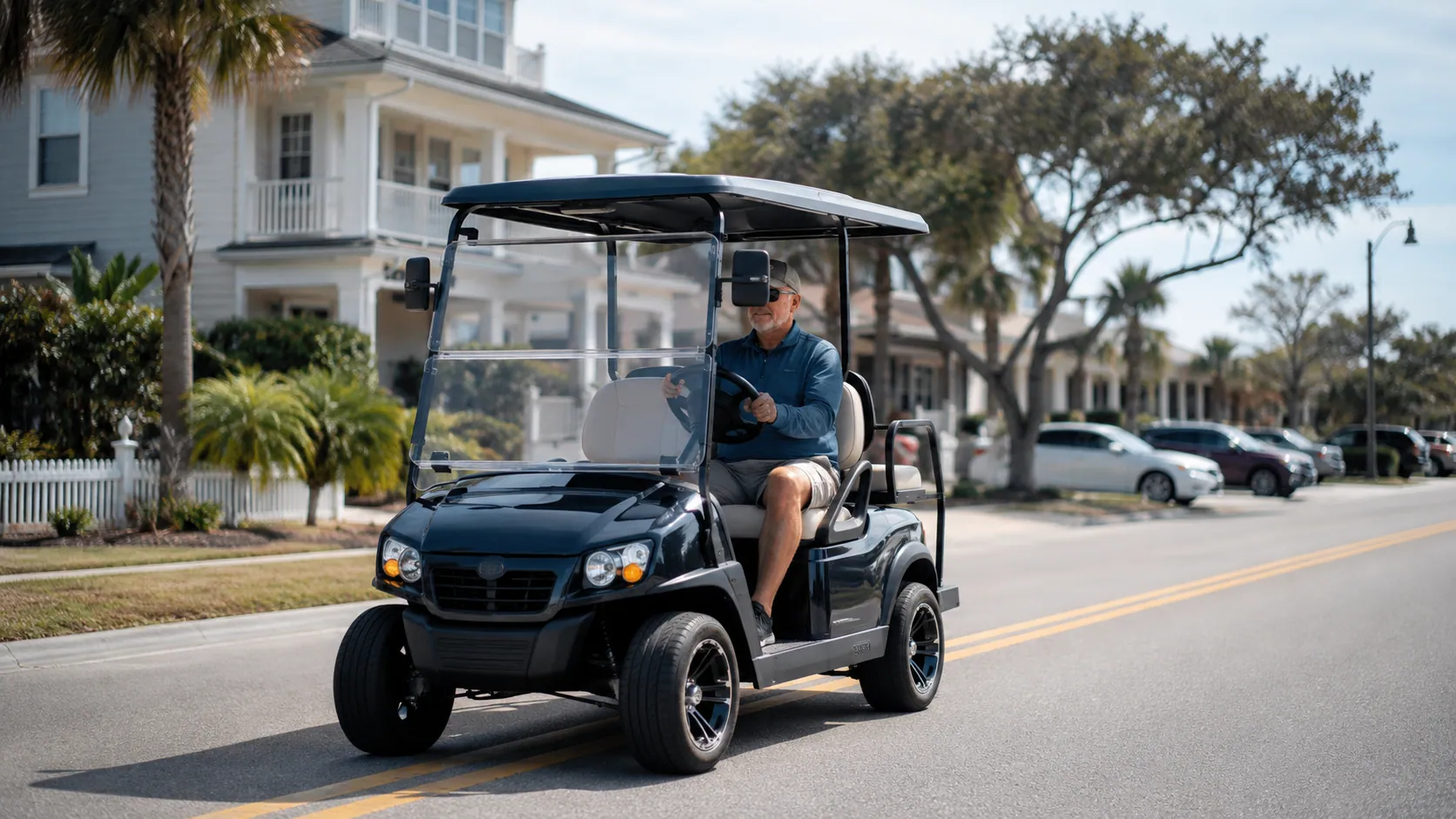
Can you drive a golf cart on the road? In some places, yes — but only when local laws allow it and the golf cart meets the required street-legal golf cart requirements, such as proper safety equipment, registration, insurance, and sometimes a license plate.
A regular golf cart is often made for golf courses, private property, resorts, or short neighborhood trips. That does not always mean it is legal on public roads. In many areas, a golf cart must be upgraded or classified as a street legal golf cart, low-speed vehicle, or neighborhood electric vehicle before it can be used on certain streets.
The rules can change depending on your state laws, city ordinance, county rules, HOA rules, and the posted speed limit of the road. That is why the safest answer is simple: before driving a golf cart on any public street, check the road, check the cart, and check the local rule.
Is It Legal to Drive a Golf Cart on the Road?
Whether it is legal to drive a golf cart on the road depends on where you live and where you plan to drive. Some cities allow golf carts on selected neighborhood streets or low-speed roads. Other places only allow a street legal golf cart or low-speed vehicle on public roads. Some areas do not allow standard golf carts on public streets at all.
This is where many people get confused. A golf cart may be fine on a golf course, private road, or private property, but that does not automatically make it legal on city streets or public roadways. Public roads are usually controlled by state laws, local laws, and sometimes the DMV or local police department.
In general, road use may depend on:
- Whether the golf cart is properly equipped
- Whether the road is approved for golf cart use
- Whether the driver has a valid driver’s license
- Whether the cart has registration, insurance, or a license plate
- Whether the road has a low enough posted speed limit
- Whether local rules allow golf carts during daylight hours or at night
For example, many communities only allow golf carts on roads with lower speed limits, such as 25 mph or less, while some low-speed vehicle rules may involve roads up to 35 mph depending on the location. The exact number is not universal, so you should always check your local ordinance.
The main point is this: golf cart laws are local. One town may welcome golf carts on residential streets, while the next town may ban them from public roads.
Golf Cart vs Street-Legal Golf Cart vs Low-Speed Vehicle
A major part of understanding golf cart road legality is knowing the difference between a standard golf cart, a street-legal golf cart, and a low-speed vehicle, also called an LSV.
A standard golf cart is usually designed for golf courses and short trips on private property. It may not have headlights, brake lights, turn signals, mirrors, seatbelts, a windshield, or other safety equipment needed for road use.
A street-legal golf cart is a golf cart that has been equipped to meet local road-use rules. It may include headlights, taillights, brake lights, turn signals, reflectors, mirrors, a horn, seatbelts, a windshield, and sometimes a vehicle identification number, or VIN.
A low-speed vehicle is usually a more formal vehicle category. LSVs are often designed to travel around 20 to 25 mph and may be allowed on roads with certain low posted speed limits, often around 35 mph or less depending on local law. A neighborhood electric vehicle, or NEV, is often similar to an LSV and is commonly used for short trips in golf cart-friendly communities.
| Vehicle Type | Common Use | Road Use |
| Standard golf cart | Golf courses, private property, neighborhoods | Usually limited unless local law allows |
| Street-legal golf cart | Approved local roads and communities | May be allowed if properly equipped |
| Low-speed vehicle / LSV | Public low-speed roads | Usually must meet stricter requirements |
| Neighborhood electric vehicle / NEV | Short local trips | Often treated like an LSV |
This difference matters because a cart that looks road-ready may still not be legally approved. A golf cart conversion kit can add safety features, but the cart may still need inspection, registration, insurance, or approval from your local authority.
What Makes a Golf Cart Street Legal?
A golf cart becomes “street legal” only when it meets the legal requirements for the area where it will be driven. There is no single national rule that applies the same way everywhere, but most street legal golf cart requirements focus on safety, visibility, identification, and accountability.
Common equipment may include headlights, taillights, brake lights, turn signals, side mirrors, a rearview mirror, reflectors, a windshield, a horn, and seatbelts. Some places may also require a parking brake, a VIN, a license plate, and proof of insurance.
Here is a simple street legal golf cart checklist:
| Requirement | Why It Matters |
| Headlights and taillights | Help others see the cart |
| Brake lights | Warn drivers behind you |
| Turn signals | Show your direction clearly |
| Mirrors | Improve visibility around traffic |
| Windshield | Protects the driver and passengers |
| Horn | Helps alert pedestrians and drivers |
| Seatbelts | Improves passenger safety |
| Reflectors | Makes the cart easier to see |
| Parking brake | Helps secure the cart when parked |
| VIN or ID number | May be needed for registration |
| Registration and license plate | May be required for public roads |
| Insurance | Helps cover accidents or damage |
It is important to understand that safety equipment alone may not be enough. A cart with lights, mirrors, and seatbelts still might not be legal on public roads unless it is approved under local rules.
Before driving, ask your local DMV, city office, police department, or county clerk whether your cart qualifies. If your neighborhood has an HOA, also check its rules. HOA approval does not always mean public-road approval.
Do You Need a License, Registration, Insurance, or License Plates?
In many places, you need a valid driver’s license to drive a golf cart on public roads. This is especially true when the cart is operated on streets shared with cars, trucks, cyclists, and pedestrians.
Age rules vary widely. Some locations may allow younger drivers on private property, while public road use often requires a licensed driver. Depending on the state or community, the minimum legal age may range from 12 to 18 years, but many areas commonly use 16 years old as the starting point for licensed road driving. In some places, a driver may need to be 15 or more years of age and under certain supervision. Because the rules vary so much, never assume children or teenagers can legally drive on roads.
For road use, a golf cart may also need:
- Registration
- License plate
- Golf cart permit
- Insurance
- Inspection
- Proof of ownership
- VIN or vehicle identification number
Insurance is especially important because golf cart accidents can still cause real damage. A cart can hit a parked car, damage a mailbox, injure a pedestrian, or cause a crash with another vehicle. Depending on the policy, coverage may include liability coverage, collision coverage, comprehensive coverage, medical payments coverage, uninsured motorist coverage, or accessory coverage.
Parents and guardians should be especially careful. If an underage driver crashes a golf cart, the owner, parent, or guardian may face liability for property damage, personal injury, or other damages.
Where Can You Drive a Golf Cart?
The answer depends on the type of road and the rules in that area. The most common mistake people make is assuming that if a golf cart can physically drive on pavement, it is allowed there. That is not always true.
Golf carts are most commonly allowed on golf courses, private property, and sometimes private roads inside a gated community or resort. They may also be allowed on certain neighborhood streets, residential roads, or approved city streets if local rules permit it.
| Location | Usually Allowed? | What to Know |
| Golf course | Usually yes | Follow course rules |
| Private property | Often yes | Owner rules apply |
| Private roads | Sometimes | Community or HOA rules may apply |
| Neighborhood streets | Sometimes | Depends on local ordinance |
| City streets | Sometimes | Usually only approved low-speed roads |
| Major roads | Usually no | Speed difference creates risk |
| Highways | Usually no | Unsafe and commonly prohibited |
| Sidewalks | Usually no | Sidewalks are for pedestrians |
| Bike lanes | Often no | Not automatically legal for carts |
| Beach towns or resorts | Sometimes | Check rental and city rules |
Many areas restrict golf carts to roads with low posted speed limits, such as 25 mph, 30 mph, or sometimes 35 mph depending on local law. Roads with faster traffic are more dangerous because golf carts are slower, lighter, and less protective than regular cars.
You should also check whether the road is an approved golf cart route. Some towns allow carts only on designated streets and may allow road crossings only at marked or authorized points.
Can You Drive a Golf Cart at Night, on Sidewalks, Bike Lanes, or Highways?
Driving a golf cart at night depends on local rules and the cart’s safety equipment. Some areas only allow golf carts during daylight hours, such as between sunrise and sunset. Others may allow night driving if the cart has proper headlights, taillights, brake lights, turn signals, and reflectors.
Even if night driving is legal, it can be risky. Golf carts are smaller and lower than regular vehicles, so other drivers may not see them quickly. If your cart has weak lights, no reflectors, or no turn signals, driving after dark can become dangerous.
Sidewalks are usually not meant for golf carts. They are designed for pedestrians, children, wheelchair users, and people walking pets. Driving a golf cart on a sidewalk can create a serious pedestrian safety issue unless local law clearly allows it.
Bike lanes are also not automatically open to golf carts. A bike lane is usually for bicycles, not motorized carts. Driving a golf cart in a bike lane can block cyclists and create confusion for drivers.
Highways and high-speed roads are generally not safe for golf carts. A cart traveling at 15 mph, 20 mph, or 25 mph can be a major hazard on a road where traffic moves at 40 mph or faster. In many areas, golf carts are banned from highways, major roads, and fast-moving public roadways.
Golf Cart Rules in Neighborhoods, HOAs, Resorts, and Beach Towns
Golf carts are popular in gated communities, retirement communities, beach towns, resort communities, campgrounds, and golf cart-friendly neighborhoods. Places like The Villages, Peachtree City, and many coastal towns are known for golf cart use, but that does not mean every community has the same rules.
In a private neighborhood, the HOA may allow golf carts on community roads. However, that permission may only apply inside the private property. Once you leave the community and enter a public road, city or state rules may apply.
Beach towns and resorts often have their own rules for rental golf carts. Tourists may assume a rental cart is allowed everywhere, but that is not always true. Rental carts may be limited to certain streets, certain times, or certain speed zones. Some towns may require the driver to be licensed, sober, and familiar with local traffic rules.
A good rule is to ask three questions before driving:
- Is this road approved for golf carts?
- Is this cart street legal or locally permitted?
- Am I allowed to drive it here under local rules?
This is especially important in vacation areas where police may ticket unsafe or illegal golf cart use.
Can You Make a Regular Golf Cart Street Legal?
Yes, in some cases, you can make a regular golf cart street legal, but it depends on the cart and the law in your area. Adding parts does not automatically make the cart legal. The cart may still need inspection, registration, insurance, a license plate, or approval from your local authority.
A typical street-legal conversion may include installing headlights, taillights, brake lights, turn signals, mirrors, seatbelts, a windshield, a horn, reflectors, and a parking brake. Some locations may also require a VIN, speed capability rules, or proof that the cart meets local road-use standards.
A conversion kit can be helpful, but you should not buy one blindly. Check whether your city, county, or state recognizes converted carts for public-road use. Some carts may not qualify because of their speed, structure, braking system, or lack of required documentation.
The cost to make a golf cart street legal can vary. You may need to pay for equipment, installation, inspection, registration, insurance, permits, and plates. For some owners, buying a prebuilt street legal golf cart or low-speed vehicle may be easier than modifying a standard cart.
What Happens If You Break Golf Cart Road Rules?
If you break golf cart road rules, you may be stopped by police, ticketed, fined, or told to remove the cart from the road. A golf cart may feel casual, but once it is used on public roads, traffic laws can apply.
Common violations may include:
- Driving on a road where golf carts are not allowed
- Driving without required registration or plate
- Driving without insurance
- Letting an underage or unlicensed driver operate the cart
- Driving at night without proper lights
- Driving in a bike lane or on a sidewalk illegally
- Carrying too many passengers
- Driving while impaired
You may also be able to get a DUI while driving a golf cart, depending on your jurisdiction. A golf cart is still a vehicle in many legal situations, especially when operated on public roads. Drinking and driving a cart can create danger for passengers, pedestrians, and other drivers.
Accidents can also create financial problems. If a golf cart hits a car, fence, mailbox, or person, the driver or owner may be responsible for damages. This is why liability coverage and safe operation matter.
Golf Cart Road Safety Tips Before You Drive
Golf carts are convenient, but they are not built like regular cars. They usually offer less protection, lower speed, smaller tires, and less crash resistance. That makes road safety very important.
Before driving, make sure your cart is visible. Use lights when required, check brake lights, test turn signals, and make sure mirrors are adjusted. If your cart has seatbelts, use them. Keep children seated at all times and never allow passengers to stand, hang off the side, or sit where there is no proper seat.
Stay on approved low-speed roads and avoid major roads whenever possible. A golf cart can easily create a traffic hazard when mixed with faster vehicles. Even if your cart can travel 25 mph, that does not mean it belongs on every road.
Drive like other vehicles can make mistakes. Use signals early, stop fully at signs, yield when required, and avoid sudden turns. Do not overload the cart with more passengers than it is designed to carry.
A simple safety rule is: if the road feels too fast, too busy, or too dangerous, do not drive the golf cart there.
Quick Checklist Before Driving a Golf Cart on the Road
Before you drive a golf cart on the road, run through this quick checklist:
- Check state laws, city ordinances, and local golf cart rules.
- Confirm the road is approved for golf cart use.
- Make sure the cart has required safety equipment.
- Check driver’s license, age, and passenger rules.
- Confirm whether registration, insurance, or a license plate is needed.
- Avoid highways, fast roads, sidewalks, and bike lanes unless clearly allowed.
- Use lights, mirrors, turn signals, and seatbelts when required.
- Never let children drive on public roads unless local law clearly allows it.
- Do not drive impaired.
- Follow normal traffic rules and posted speed limits.
This checklist can help you avoid tickets, fines, unsafe situations, and insurance problems.
UK Note: Golf Buggy Road and Pavement Rules
In the UK, people often use the term golf buggy instead of golf cart. The rules can be different from U.S. golf cart laws, especially when a buggy is treated as a Class 2 mobility scooter or Class 2 mobility vehicle.
Some golf buggies may be limited to pavement or footpath use at around 4 mph, while other settings such as 8 mph golf course mode may be used in golf course environments. Some electric buggies may advertise practical features such as lithium battery power, a full charge, or a range such as 45 km, but battery range does not decide road legality.
If you are in the UK, check local mobility scooter, pavement, road crossing, and golf buggy rules before using a buggy away from the golf course.
Frequently Asked Questions
Can you drive a golf cart in a neighborhood?
Sometimes, yes. Many people use golf carts on neighborhood streets, especially in golf cart-friendly communities. However, the cart may need to meet local rules, and the road may need to be approved for golf cart use.
Can you drive a golf cart on the sidewalk?
Usually no. Sidewalks are normally for pedestrians, not golf carts. Some local rules may make exceptions, but you should never assume sidewalk use is legal.
Can you drive a golf cart on the highway?
Usually no. Highways and major roads are generally too fast and dangerous for golf carts. Most golf carts are better suited for low-speed local roads, private roads, or golf courses.
Do golf carts have to follow traffic laws?
Yes, when used on public roads, golf carts often must follow traffic laws. That may include stopping at stop signs, yielding, using signals, obeying speed limits, and avoiding impaired driving.
Can you get a DUI on a golf cart?
Yes, in many places, you can get a DUI while driving a golf cart, especially on public roads. Alcohol rules can still apply even if the vehicle is small and slow.
Do golf carts need insurance?
Many areas require insurance for golf carts used on public roads. Even where it is not required, insurance can help protect you from liability after an accident.
Can kids drive golf carts on roads?
Usually not unless local law clearly allows it. Public road use often requires a valid driver’s license or a minimum legal age. Parents and guardians may be responsible if an underage driver causes an accident.
Can rental golf carts go on public streets?
Sometimes, but only where local law allows it. Rental golf carts in beach towns, resorts, or vacation communities may be limited to approved streets and licensed drivers.
Conclusion: Check the Road, the Cart, and the Local Rule First
So, can you drive a golf cart on the road? The answer is yes in some places, but not everywhere. A golf cart must usually meet local street-legal requirements, and the road itself must be approved for golf cart use.
Before driving, check your local laws, confirm whether you need a driver’s license, registration, insurance, or a license plate, and make sure your cart has the right safety equipment. Do not assume a regular golf cart is legal just because people in your neighborhood use one.
Disclaimer:
This article is for general informational purposes only and should not be considered legal or safety advice. Golf cart road rules, street-legal requirements, licensing, registration, insurance, and permitted roads can vary by state, city, county, HOA, and local ordinance. Always check your local laws and speak with the relevant DMV, police department, or local authority before driving a golf cart on public roads.